
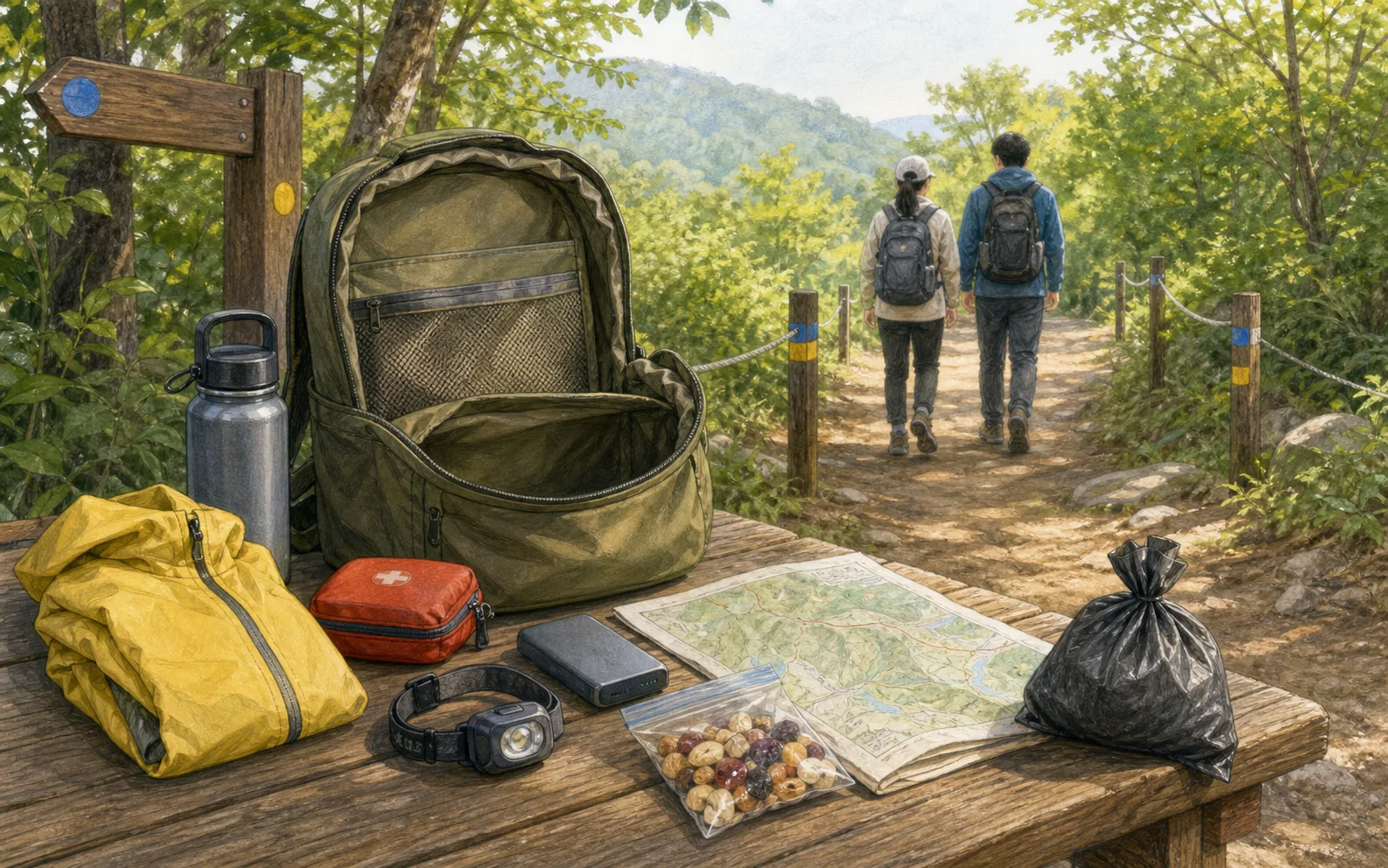
For a first outing, finishing comfortably matters more than going far or climbing high. Pick a familiar, well-marked trail and plan enough time to return before dark.
Key point Choose a two-to-three-hour route, carry only the essentials, and walk at a pace where you can speak in full sentences.
먼저 확인할 것
- Start with a well-marked route that takes about two to three hours.
- Check all Ten Essentials for the route: navigation, sun protection, insulation, light, first aid, fire, repair tools, extra food and water, and emergency shelter.
- Slow down before you feel winded, and save energy for the descent.
Choose a forgiving route
A low mountain or local trail with clear signs is a better first choice than a route selected only for its summit view. Check distance, elevation gain, trail condition, weather, and sunset time before leaving.
Tell someone where you are going and when you expect to return. If rain, strong wind, heat, or poor visibility makes the route uncertain, postpone the hike.
Scope of the Bukhansan grade and closure page
The linked Korea National Park Service page is an example for checking Bukhansan trail grades and closures; it does not represent conditions on other mountains.
Source: Korea National Park Service: Bukhansan trail-grade and closure example
Pack the essentials, not a heavy bag
Carry enough water for the weather and route, plus a simple snack such as nuts, fruit, or an energy bar. Wear shoes with traction and socks that do not rub.
Check navigation with a paper backup, sun protection, insulation and rain protection, light, first aid, fire, repair tools, extra food and water, and emergency shelter for the route. A phone is only a backup: save an offline map and carry an extra battery.
Source: U.S. National Park Service: Ten Essentials and sharing return plans · U.S. National Park Service: changing weather and not relying on a phone alone
Use the conversation test
Begin more slowly than feels necessary. If you cannot speak a full sentence without gasping, shorten your stride and reduce the pace. Brief, regular breaks work better than pushing hard and taking one long stop.
Drink before you become very thirsty and eat a little before your energy drops. Turn around at the planned time even if the summit is close.
The hike includes getting back safely
Before leaving, tell someone your route and expected return time. Set a turnaround time based on daylight, fitness, and weather, and turn back at that time even if the summit is close.
Stay on the designated trail, go with others when possible, and do not rely on phone service alone. The linked KNPS page is only a Bukhansan example; check the managing authority for the place you will actually hike.
Source: U.S. National Park Service: Ten Essentials and sharing return plans · U.S. National Park Service: changing weather and not relying on a phone alone · Korea National Park Service: Bukhansan trail-grade and closure example
Notes
- Route time varies with weather, surface conditions, rest breaks, and individual fitness.
- Check current closures and weather from the local managing authority immediately before departure; change the plan when a closure or warning applies.
Sources
- Checked
- 2026-08-05
- Scope
- Buddyzone checked this packing guidance against public NPS and Korea National Park Service safety information.
- Notes
- General day-hike guidance; it does not replace local closures, rescue instructions, medical advice, or professional mountain training.